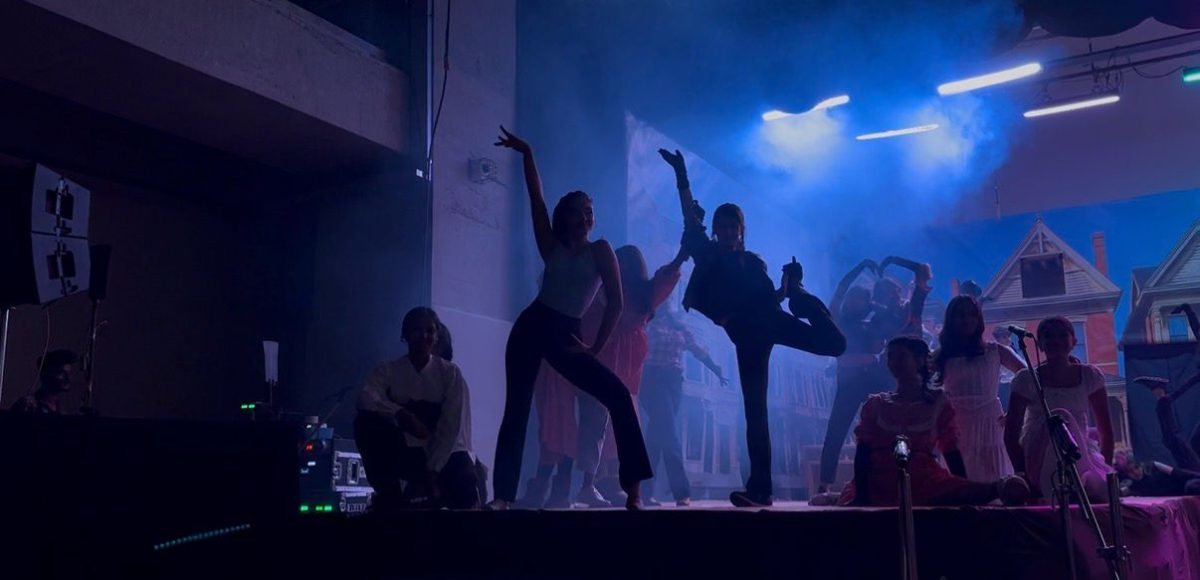
The spotlight blinds you, both literally and figuratively. Your audience fades to black, and any nerves you feel melt away. As your eyes adjust, you gain confidence with every passing moment and soon start to feed off the energy of the crowd. For any performer, this moment is the culmination of days or weeks or even months of hard work. As I walked on stage during the School Concert this past December, I wondered if I was ready. I was recovering from a knee injury, and this was the first time I had danced for the school. However, when that spotlight hit, I felt the magic again, but this time, it was within school walls.
I had a part time job at 13. Over the next two years, I went full time and took on more responsibility. You might be wondering if this goes against child labour laws. No. It was the cost of pursuing my passion for dance outside of school. Until recently, I averaged nearly a full work week in a dance professional development program. Despite years of external training and professional-level commitment to dance, I had never performed for my own school. Creative pursuits were something I sustained alongside academics, often at considerable personal and physical cost, rather than something integrated into the school experience. Performing on that stage for the first time highlighted the extent to which institutional recognition shapes a student’s sense of belonging. That is why I am so happy about Ascend’s recent push to give us meaningful creative opportunities. The school must continue to drive creative arts, as the third pillar to our development, joining academics and sports.
To step onto a stage is to be momentarily affirmed by the institution that built it. This year’s production of The Greatest Showman represented a clear departure from previous school performances. While last year’s orchestra was both refined and musically strong, it centered a single mode of performance. Our recent show, in contrast, integrated singing, acting, dancing, and live instrumentation within a unified narrative. For students whose artistic training has largely existed outside the school environment, it was a significant shift. It marked one of the first moments in which the school stage reflected the full range of creative identities present within the student body.
This difference was also visible in the standard of execution and visual design. Although Ascend had hosted performance based events in previous years, this production reflected a higher level of planning and aesthetic ambition, with technical elements such as lighting, staging, and 3-Dimensional space integrated into the overall narrative. Notably, Ahana Gandhi from Grade 10 walked out to sing her solo of Never Enough on the 6th floor balcony, prompting the audience to quite literally, turn heads.
The set design of the production was particularly striking. After a strenuous round of exams, the older students returned to rehearsals having been largely disconnected from the production process. Walking into the space, I was met with expansive backdrops, carefully constructed props (thanks to Ms. Naznin), and a fully assembled circus tent on the stage! It goes without saying, but it was a surreal experience. It was the first time Ascend, as a school, invested so visibly and deliberately in a creative space that reflected the scale and seriousness of professional performance. More personally, it allowed me to imagine my own artistic identity existing fully within a place I consider a second home, while offering me a glimpse into what the future of performing arts at Ascend could look like.
The performing arts demand sustained discipline, collaboration, leadership, and resilience, yet these qualities have traditionally been more readily recognised in academic and athletic contexts. By offering a platform that treated creative work with comparable seriousness and structure, the school signaled a growing recognition that student development extends beyond conventional markers of achievement. Ascend’s recent efforts to create meaningful creative opportunities suggest the possibility of a more balanced educational model, one in which the arts are integrated into the core of school life rather than existing at its margins. The December concert stands as a strong indication of what can be achieved, when artistic expression is supported with both intention and institutional commitment, and it offers a promising foundation for the future of performing arts at the school.
And so, as the lights dimmed and the applause settled, I held my final pose. My arms were shaking, my breath uneven, and my heart was racing, not from nervousness anymore, but from a sense of catharsis. When I stepped off the stage, I saw younger students waiting backstage, watching with wide eyes. I felt both proud and at ease to know that this is what the future of Ascend holds for them. That in itself, is a jeté in the right direction.